Wednesday, March 18, 2015

The Passion and Springtime of the Church

There's a remarkably widespread opinion amongst prominent Churchmen that the Church is entering a passion.  Just as Christ took on his passion as he walked among us, so must the Church--his mystical body--undergo her passions as she journeys through the centuries.  Christ endured rejection, abandonment and terrible wounds, and so must the Church.

This gloomy consensus seems to cut across generations and even theological differences.  Karl Rahner SJ, a giant of the Second Vatican Council and favorite amongst progressives, opined that in the future the church would only be composed of mystics.  Fr. John Hardon SJ, a tradition-minded theologian, said that only the very humble or very chaste would remain faithful.  In 1969, Cardinal Ratzinger (the future Pope Benedict XVI) offered some hopeful, poetic words even amidst a post-Christian future.  He predicted that after a falling-away, the world "will discover the little flock of believers as something wholly new."  The whole passage is worth reading here.  One industrious author has even assembled the apocalyptic warnings of the popes from the past two-hundred years.  It's a meticulously documented though tiring book: Heralds of the Second Coming.  Some might object that two hundred years sounds like an awful slow warning, but apostasies are often slow motion events; that is, until they're not.  Spiritual bankruptcy is a lot like Hemingway's description of financial bankruptcy: it "happens in two ways: gradually then suddenly."  In Quebec, Canada, it is said that most of the province ceased going to mass over the course of a few months in 1966.  Obviously the Devil had been laying his groundwork long before that.

About eighteen months before God invited me to take up the apostolate, I had a supernatural experience of the passion of the Church.  It was an event that at first seemed apocalyptic, and later full of omens and portents.  As I've grown deeper in the faith, I now view the experience as an invitation and a sober warning rather than a glimpse of the End Times.  It happened on Monday of Holy Week, April 2, 2012, while I was driving home from a hike in the Columbia River Gorge.  I had just laid down my rosary beads to focus on the drive home when there was a sudden change in the skyline: there was a massive new celestial body in the sky.  I was startled and thought Christ had come, "like a thief in the night", to finally reconcile all things to himself.  But I remembered that the signs of the End Times had not been fulfilled, and then I noticed that the other drivers did not see the celestial body.  I calmed myself and watched: it was a bright disc that seemed like a second sun.  It was the identical size and shape as the sun, and was directly across from the sun in the sky, on the same geometric plane.

Then the second sun began to move across the sky at a deliberate pace.  As I watched the second sun, I saw that it wasn't like the real sun, but seemed an imitation, or worse, a counterfeit.  Whereas the true sun gave forth its warm, radiant yellow light, the second sun was a cool silver, shining and yet sterile and cold.  Then I realized that the second sun was moving across the sky to cover the true sun, and its movement took on a quietly ominous movement.  As it approached closer and closer--seemingly inevitable and unstoppable--the true sun seemed not to notice.  Perhaps the true sun was too regal to recognize its rival, or was resigned and at peace at the approaching counterfeit.  When the second sun finally reached the true sun, there were no fireworks or spectacles: the true sun serenely absorbed the counterfeit sun and it was gone in an instant.

Two days later, Wednesday of Holy Week, Christ asked, "Won't you share my passion?"  My spiritual director and I shared the same interpretation of the experiences.  The sun is an icon of Christ.  The second or counterfeit sun, is the spirit of anti-Christ, a false gospel that many mistake for the true Gospel, and which is ascendant in vast swaths of the world.  It's an anti-gospel of scientism, materialism, individualism, sexual liberation, idle entertainment, and the glory of man at the expense of the cross and the love of God.  As men increasingly prefer the anti-gospel to the Gospel, the Church will be abandoned and betrayed.  The cheering crowds from Palm Sunday will scatter, the apostles will hide and dissemble, and there is always Judas.

The Church, the new Israel, has undergone many passions over the millennia, just as the old Israel did  before Christ's coming.  Some saints and spiritual writers have said that every generation has its passion, though some passions are clearly worse than others.  A week or so after his passion, Christ appeared to the apostles and calmly spoke, "Peace be with you."  Then he said it again, because he knows we are poor listeners, "Peace be with you."  Christ, the true sun, is always at peace even as the false suns move across the sky.  The false suns always seem confident of victory; their triumph appears unimpeded and sure, and yet they are effortlessly swallowed up by the true sun.

The Springtime


In every passion there is a Springtime, those moments of resurrection and new life.  St. John Paul II famously predicted a "new springtime" for the Church, but he also famously declared in 1978 that we have entered "the final confrontation between the Church and the anti-Church, of the Gospel versus the anti-Gospel".  So how do we square these two prophecies?  In the mind of the Church there is no contradiction.  The history of our faith is ancient and sure, and we mustn't think as the world thinks.  Throughout the centuries, the Church has always been most fecund in times of crisis--just as our Lord's greatest triumph came with his bloodshed.  Thus, the Church has always had a maxim, articulated by Tertullian, "the blood of the martyrs is the seed of the Church".  Sometimes the martyrdom runs red with blood as we now see in parts of Africa, the Middle East and even Asia, and sometimes it is the "white" martyrdom of willingly losing most of what you hold dear.

Even if we're not called to red or white martyrdom, new life will spring from our faith and sacrifices.  He is asking us to overcome ourselves with grace, and share in the sufferings to come.  If we share in his passion, then the Church will enjoy a resurrection, a new springtime.

Three weeks ago my wife gave birth to a baby boy, Gabriel Kristoff.  My wife remained open to life even after two straight miscarriages, and the challenges that come with childbirth in your 40s. That's faith and a sign of Spring.

In another sign of Spring, Daniel O'Connor, a young man from Albany, New York has been evangelizing the streets in his Sunday best and a giant Divine Mercy button.  He has invited others to join him here.  I noticed that Daniel has a similar take on the "signs of the times" even as he sets out to evangelize.  My next post will be a meditation on this seeming paradox: Christ invites us to follow him even as he signals that the tide is coming in against us.

Finally, a few weeks back I sent Josh his tunic to evangelize in Louisville.  He had only been wearing an old sweatshirt with the Jesus Caritas heart.  Now he's eager for Spring to melt the snow so he can resume walking the streets.  Springtime is coming, and the Lord comes with it.

Josh's wool tunic is several shades darker than mine

Saturday, February 21, 2015

Reflections on Evangelization, II: Spiritual Growth through Evangelization

Yesterday I walked the streets for the final time before my wife has our baby boy.  It was a spirit-filled experience, not least because I read the second half of Matthew Manint's free little e-book, Like a Dove in the Cleft of a Rock.  It is a beautiful spiritual meditation by a consecrated layman with a special devotion to Blessed Charles de Foucauld.  I found myself repeating the plea to our Lord,

"Draw me after you, let us make haste."

Lord, draw me up after you, and help me follow your quick steps up the holy mountain.  Let us make haste, the time is short.

I'm happy to say that my prayers have not been in vain.  The Lord has drawn me up after him, and the vehicle of my sanctification has been my ministry on the streets.  In fact, I have been the great beneficiary of my own evangelization efforts!  I only wish I could say that those on the street have benefited as much.

One way to witness my spiritual growth is to consider some of the changes in my perception of the ministry and it's challenges.  One shift in perception concerns how I inwardly respond to verbal abuse.  When I first began the apostolate, I was mildly disturbed by hostile stares or angry shouts from passing cars, but I would consciously offer it up to God the Father as a small sacrifice.  Then after a few months I ceased to be disturbed, and walked on in peace--happy to be of some use to God, but sorrowful for the sake of the angry person.  But yesterday God gave me the grace to take things a little deeper.  A shrill voice yelled from a passing car, "Go to hell!"  And for the first time I realized, "Lord, I'm not worthy to be despised for your sake.  Who am I to be given such a great grace as to be despised for doing your will?"  That thought had never occurred to me before, but now it seemed so obvious.  I used to think I was a splendid candidate to suffer for our Lord, how could I have been so presumptuous?

A similar shift in perception concerns my attitude toward the apostolate itself.  When I first began the apostolate, I did it largely from a sense of duty and curiosity.  But I quickly discovered that it was painful to walk the streets: the weather was often bad, my feet and joints were tired, the tunic was awkward and I stood out amidst passers-by, there was the occasional abuse, and the spiritual combat was especially draining.  I even had to fight off feelings of resentment, "Thanks a lot God for giving me this thankless ministry."  But I grudgingly endured it, and forced myself out the door, week after week.  Then the gloom broke and I began to be at peace with the ministry, and it just became a part of my weekly schedule and who I am.  Then yesterday God gave me an even deeper grace.  For the first time I realized that I was blessed to be given this ministry.  It was a conviction of the heart, and not an intellectual exercise.  I didn't even give myself reasons, I just knew it to be true.  

In just one short year I have progressed from resenting and grappling with the ministry to embracing it as a great blessing.  It seems paradoxical that evangelizing others would offer a considerable source for our own sanctification. After all, we presumably evangelize out of love for others and God, and not for our own sake.  But when we commit ourselves, week in and week out, to share the Gospel with those who lack it, Christ slowly saturates our own hearts with his love.  In making this sacrifice for the sanctification of others, we are doing what Christ did in becoming man and accepting the cross for us.  By imitating him, we become more like him, the "holy one of God".  At first our hearts are small and hard, but if we persevere then they swell and grow until they begin to more closely resemble his own.  Then the more closely they resemble his own, the more efficacious our efforts at evangelization.  He is always trying to build us up since he desires to do his work through us, but we always slow the progress!

So if you want to be holy, then sacrifice for the sanctification of others.  Evangelize the streets, evangelize and pray for your friends and neighbors, pray and counsel outside Planned Parenthood, and you'll soon find that you are growing closer to Christ.  It's a paradox of the spiritual life, but then again, most of the deep truths of our faith are counter-intuitive.

Tuesday, February 10, 2015

Reflections on Evangelization: Laughter should come easy

"May the good Lord deliver us from gloomy saints!"
                                                                            --St. Teresa of Avila

Humor is essential for growth in the spiritual life.  It is therapeutic and refreshing, lifting the weight of our cares. In fact, abiding humor is a sign of a healthy soul.  But it isn't just any form of humor, for even the demons laugh and find some refreshment in their jokes and gags.  The humor of demons' springs from malice and pride--their jokes always point back to their own prowess or cleverness, and what they find easy to despise (namely, us).  As Christians, it should be expected that our sources of humor run in the opposite direction: not in pride, but in our littleness and dependence on God; not in our own craft, but in welcoming the providential surprises of God; not in despising the follies of his "poor banished children of Eve", but in a gently pitying mirth.  

In the past several decades we have all heard laymen and religious reject talk of sin, the devil and spiritual warfare as gloomy and destructive of joy, but they have it exactly wrong.  In fact, it is only through a sober understanding of sin that we are freed for the joyful fruits of humility, and it it only by living each day in spiritual combat that we can laugh at our topsy-turvy world.  An abiding sense of our sin and weakness is not a psychological or spiritual handicap, it is actually a great grace from God!  Once we recognize our dependence on God's mercy and our need for angelic aid, then we will have the ability to laugh at ourselves and our circumstances.

There have been many amusing moments as I walk the streets and many of those moments point back to my own weakness and foolishness.  I think, for example, of the first time I walked the streets in my freshly sewn tunic.  A powerful wind repeatedly blew the front 'yoke' of my tunic with the Jesus Caritas heart right back into my face.  I'm sure the demons had a good laugh and I conceded it was funny since I had set out with such a solemn sense of purpose, a hidden belief in my own importance.  On another occasion a woman who knew how to party (what some people call a 'barfly') saw me coming and stepped out in front of me to block my path.  She straddled the sidewalk in her faded jean shorts, and firmly planted her hands against the pink tank top at her hips.  I looked into her wrinkled tan face, at the black eye-liner and sparkling lip gloss, and watched her erupt in hoarse laughter as she reached out and poked at my tunic.  I immediately joined her laughter.  She was right:  I looked like a fool, like a wayward time-traveller walking the streets.  If a Christian can't laugh--especially at himself--then he is finished.  He will collapse under the weight of his own seriousness and the gravity of the times.  He will collapse because he has secretly placed himself at the center of things rather than trusting that Christ has overcome the world.

St. Therese having some fun as Joan of Arc


The other day I was gripped by the seeming absurdity, the utter implausibility, of the traditional Catholic worldview.  In the age of microscopes that can peer at "invisible" organisms, and telescopes that can examine distant solar systems, who can still maintain a belief in invisible spirits--both holy and wicked?  Who can believe that all of our good and wicked actions will reverberate into eternity?  Where is this all-powerful, all-knowing, all-loving God with his Kingdom of Heaven and barren desert of Hell?  Hasn't science, the ingenuity and industry of man, uncovered everything and finally rendered life safe and predictable?  Mankind no longer has to cower in caves, fearful of the creatures in the forest, mysterious diseases and the wrath of the gods.  Civilization has finally won!  Or so it seems.

But all is not what it seems, and the faithful Christian needs a healthy sense of humor about these things.  When I walk the streets and a wounded, self-righteous person glowers at me as though I am his enemy, I laugh inwardly because he has it exactly wrong.  It is a moment of absurdity.  So often I want to say, "But I am the best friend you've got!  I will pray and sacrifice for you, and I want nothing in return.  But those whom you call your "friends", what do they want from you?"

We must have humility, humor and gratitude because the scales have fallen from our eyes, and what God has kept from the learned and powerful, he has revealed to the little ones.  It is a great grace and a great responsibility.  May we have the good humor to continue undisturbed along the Lord's path.

Thursday, January 8, 2015

Where are the Catholic Street Evangelists?

Many, many people hereabouts are not becoming Christians for one reason only: there is nobody to make them Christians.  Again and again I have thought of going round the universities of Europe, especially Paris, and everywhere crying out like a madman, riveting the attention of those with more learning than charity: "What a tragedy: how many souls are being shut out of heaven and falling into hell, thanks to you!"  I wish they would work as hard at this as they do at their books, and so settle their account with God for their learning and talents entrusted to them.    
                                             --St. Francis Xavier, from a letter recently featured in the Divine Office

The saints have a way of getting our attention.  Today the Church is blessed with countless laymen whom God has entrusted with "learning and talents", and yet so few take the faith to the streets.  Pope Francis has even implored Catholics to go out into the world, but perhaps his call has gotten lost in the headlines.  There is an abundance of Catholic books on seemingly every subject (with more published every year), and there is a dizzying number of online ministries and blogs, and yet all we see on the streets are Mormons, Jehovah's Witnesses and the occasional fundamentalist.  Yet St. Paul, the most piercing theologian the Church has ever known, was also her most tireless street evangelist.

The great saints agree that writing is secondary to the direct care of souls.  St. John Marie Vianney, the Cure of Ars, writes, "St. Francis de Sales, that great saint, would leave off writing with the letter of a word half-formed, in order to reply to an interruption."  In other words, any human need, any interruption by a soul "made in the image and likeness of God" commanded his attention over the demands of his writing ministry.  He still managed to write his pamphlets and books, but they were secondary to his face-to-face encounters with his fellow man.

Writing a book or managing a website can be an enjoyable and rewarding use of our time, but it can also be a time-comsuming process that only yields a small circulation among readers.  I'm writing a book like everyone else (hopefully my only book), and whenever I have a block of free time I ask God, "Should I write my book, or do the street ministry?" I always get the same impression: I should walk the streets.  The book will get done, but on God's schedule.  In fact, there's a secret: if I walk the streets when called, the next time I sit down to write, the word pours out quick and fresh. God's grace more than compensates for the time I've "lost" writing my book.  But it also goes deeper than that.  The material I write is also livelier because street evangelization rekindles the sacred fountains of the Christian imagination.


There are many reasons Christians don't pursue street ministry, but there seems to be one universal reaction to the apostolate: "Be safe!" or "Be careful out there."  or "That sounds dangerous."  Now there are better neighborhoods to walk if you'd like, and all neighborhoods need a visible Catholic presence, but I've been walking the grittier streets for a year and I've never felt threatened.  Not once.  The threat seems to be in the mind.  Perhaps the real threat, is walking out our front door and mixing with those we don't normally associate with.  The prostitutes, the angry young men, the at-risk youth, the addicts, the ex-cons.  But sometimes they are better company, more real, more compassionate, more substantial than we could ever imagine.  For my part, I used to sit in academic conferences and listen to secular professors and graduate students indulge in dreamy, narcissistic "social theorizing", and think, "I actually prefer the company of my solid cons back in maximum security prison.  At least they know what real life is like, what it means to love and hate and suffer and struggle."

But it's easy to see why people avoid doing street ministry.  Take last night, for example.  As I passed a food cart pavillion on SE 82nd, two young men jeered at me in between eating Philly cheesesteaks.  They hoped they might get a rise out of me, and so they shouted louder and louder until I was gone.  Then a john and a prostitute in her early twenties passed me traveling in the opposite direction.  She wore an electric pink down jacket and cap, and wearily trailed the john by three yards.  As I passed she gave me a sarcastic reproach, "Sorry I spit on the sidewalk."  A half hour later I passed the john again, but he was alone this time.  He cast his head down and avoided making eye contact again, but this time his head gave an unnatural jerk to the side as I passed, as a man flinches when a flashlight is shone in his eyes. I thought it had a spiritual significance, as though he were recoiling from Christ.  Perhaps it was like the reprobate who dies and then impulsively flees from the Lord upon seeing the glory of His love.


Fifteen minutes later I saw the young prostitute by the entrance of 7/11, waiting for the next john.  It's the usual hang out for prostitutes and the rare pimp.  She saw my discreet wave, but just stood watching me.  I couldn't read her expression. I kept looking back in the hope she would leave her post to talk, but she just watched me until I passed out of sight.

When I was near home, I passed the window of a little shop on Foster that had recently changed hands.  The shop used to be called "Vice", and sold smoking paraphernalia, lingerie, lubricants and sex toys.  Now it had a large poster in the window with a Latin title and symbols that seemed Catholic at first glance.  I felt a twinge of hope, maybe I've got some new friends in the neighborhood!  The poster had a dove and a cross and a chalice, with the title "Ordo Templi Orientis". But as I looked closer I realized the poster was merely aping Catholic imagery, and was an occultist inversion of the faith. When I got home I googled the name, and saw it was a secret esoteric society once associated with Aleister Crowley. Now this "secret society" is silly nonsense, a self-important pipe-dream of two or three lonely souls in the neighborhood, but they need prayer and sacrifice.

In fact, our cities are full of people just like the ones I met last night, and we desperately need Christians to witness to them.  Our Lord's words are timeless, "The harvest is plentiful, but the laborers are few."  Join St. Paul Street Evangelization, witness at Planned Parenthood every week, visit the abandoned in care facilities, or even start your own street apostolate.  But get out there!

Monday, December 1, 2014

Happy Feast Day, Blessed Charles!

Today is the Feast Day of Blessed Charles de Foucauld, patron of the apostolate and of so many other worthy lay and religious groups.  He was murdered 98 years ago today by an anxious young tribesman who was assigned to guard him while the rest of the warriors pillaged Charles's little compound.  In honor of his feast, I was intent on walking the streets today, and I had some hope that something special might happen.  I wasn't disappointed.  Well, at least I wasn't disappointed in Blessed Charles's sense of humor.  A cheerfully intoxicated fifty year-old woman followed me and insisted that I share her fried chicken leg.  Perhaps the chicken was meant for Blessed Charles's feast?  If so, I missed the clue. Instead I managed to distract her enough with friendly questions to avoid eating the leg.  She was great fun though, and could certainly use a few prayers.


After walking the streets I went to the archdiocese to talk to Todd Cooper, the acting Director of Evangelization, about the apostolate.  He was surprised when I pointed out that he had scheduled the meeting on Blessed Charles's Feast day, but as we know, Heaven is full of surprises.  I think the meeting was very rewarding for both us, and he was very patient when I went to tears talking about some of my old convict buddies.  Some of those buddies did me a great deal of good behind bars, and they are still in prison today.  Todd assured me I had Archbishop Sample's blessing, and said that when it comes to street ministry, "You're all we've got."  That made my eyes widen, and I felt like stepping out into the cold to resume the apostolate.  I'm sure the Lord will send Portland more workers soon since we know that Heaven's not stingy. God has already sent us Josh in Louisville, and there are plenty of good men in Portland.  My Mom's already agreed to sew two tunics to have on hand, and I've already got the fabric ready!

Friday, November 21, 2014

A Model for the Re-evangelization of the West

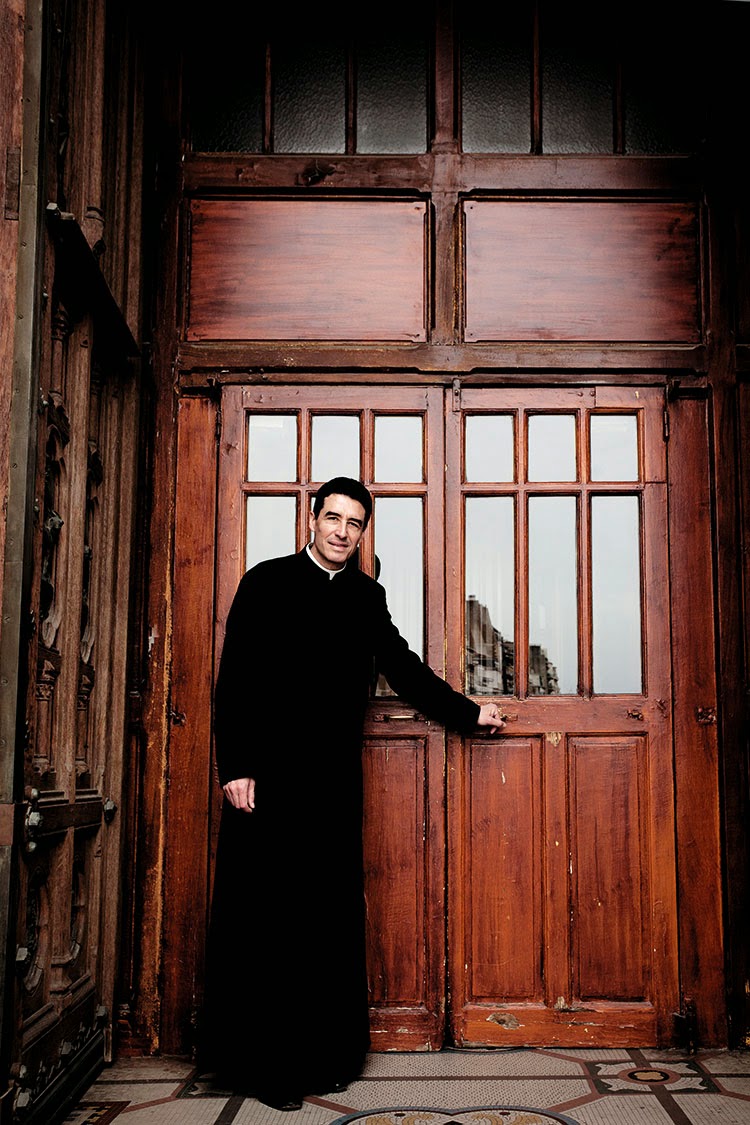
For the last decade Fr. Michel-Marie Zanotti-Sorkine has walked the gritty streets of Marseille, France in a cassock.  He walks the streets so that he might know all of his people, and he patiently waits for them every evening in the confessional.  He has brought many back to the faith, and has earned the respect of all the people of the diverse seaside metropolis.  The parish he was given was once almost empty, and now it is the busiest parish in Marseille.  His example has not gone unnoticed.  In fact, he has even inspired the good Archbishop Leonard of Brussels to found the Fraternity of the Holy Apostles after Fr. Zanotti-Sorkine's example.  The Fraternity has begun with three priests and seven seminarians, and has recently found a home in the once-closed old St Catherines'.  Like Father Zanotti-Sorkine, they walk highly-secularized Brussels in cassocks, and they bring the Gospel and sacraments to those who wouldn't otherwise seek them.


Fr. Zanotti-Sorkine has given us a model for how to re-evangelize the West.  He offers something old and something new to bring his people to the wedding feast of our Lord.  With his traditional dress, devotion to the confessional, and reverent mass he has reached deep into the time-honored treasures of the Church, and has been called another Cure of Ars.  His commitment to walking the neighborhoods is reminiscent of the early Franciscans and Dominicans, and represents the perennial missionary spirit of the Church.  He has also been adept at using modern technology to reach people through various forms of media: books, interviews, online sermons and even music.  God seems to have given him more hours in the day than the rest of us, and his success has earned him more than his fair share of critics.  Some critics find him too traditional, other critics object to the fact that he gives our eucharistic Lord to prostitutes (I would be ecstatic if some of the prostitutes I see every week would join me in confession and mass!), or that he has an attractive website and following.  He has taken some pastoral risks, but has also shown great faith in laboring for the Lord.  Who knows how long he walked the streets in his cassock before people finally relaxed and welcomed him?  And who knows how long he sat in the confessional--night after night--before people finally began to trickle in?  In his ten years at the parish of St. Vincent de Paul, the good father has shown us that Catholicism still works.  What worked for Sts. Francis and Dominic will still work for today, and what revitalized the village of Ars under St. Vianney can still happen in parishes today.

Fr. Sorkine and the Fraternity

Fr. Zanotti-Sorkine has recently taken a new assignment at the Shrine of Our Lady of Laus.  We wish him all of God's blessings, and also for the good priests and seminarians of the Fraternity of the Holy Apostles.

Wednesday, November 19, 2014

How Blessed Charles was Converted


The other day while doing the ministry I was reading the old Bazin biography of Blessed Charles de Foucauld.  It's my book of choice while walking the streets, while waiting "for something to happen".   I came upon the part of the book where Blessed Charles first met the priest who was to play a decisive role in bringing him back to the Church.  He met Father Huvelin at a fashionable salon or evening party when he was fresh off his great success as an explorer and geographical writer.  Charles was a sought-after personage at the time, yet his soul was restless.  Unbeknownst to himself, his soul was ripe for conversion as his objects of desire had faded in disillusion.  First he had tasted of life as a young viscount, as a man of exquisite luxury and as a man with an amiable mistress.  Then he had excelled in perilous situations as few men do: first as a cavalry officer in combat and then as an undercover explorer in the hard, hostile land of North Africa.  While he had finally come into his manhood and sense of himself, there was still an unease that dogged him.  He was aware that he lacked the peace and ease of spirit that marked his devout relations, and their Christian example was not lost on him.

But what Charles needed was a catalyst, to meet just the right person or more accurately, just the right friend.  He found that in Father Huvelin.  It seemed like  a "chance" encounter at the salon, though we know that with God there is no element of chance.  Father Huvelin had gone to the best of schools, though he was not at ease with the luxury and the privilege of high society.  The Bazin biography tells us that he "did not try to be smart" in Charles's presence, but was just himself: an unassuming blend of simplicity, profundity and earnestness.  Somehow, perhaps by an instinct in the soul, the two men recognized in each other a common bond and joined destiny.  Bazin beautifully tells us that "“they recognized and waited for one another in their hearts", and later considered their meeting "a great event”.

I was amazed at reading these passages because they capture the central purpose of the apostolate.  Blessed Charles's own conversion is a model of how the apostolate approaches the spiritually famished in order to forge a genuine connection.  While life-changing friendships are rare, we walk the streets in the hope that God will put us in just the right place to meet just the right person.  A conversion to Christ usually comes through human relationships, and this makes sense when you consider that the committed faithful are members of Christ's own mystical body.  Thus, if we share in Christ's divine life, then in meeting us they are meeting Christ in us.  God has given all of us a great privilege and responsibility to go out and bring Christ to others, and the surest way of bearing Christ is through the Eucharist.