Today is the Feast Day of Blessed Charles de Foucauld, patron of the apostolate and of so many other worthy lay and religious groups. He was murdered 98 years ago today by an anxious young tribesman who was assigned to guard him while the rest of the warriors pillaged Charles's little compound. In honor of his feast, I was intent on walking the streets today, and I had some hope that something special might happen. I wasn't disappointed. Well, at least I wasn't disappointed in Blessed Charles's sense of humor. A cheerfully intoxicated fifty year-old woman followed me and insisted that I share her fried chicken leg. Perhaps the chicken was meant for Blessed Charles's feast? If so, I missed the clue. Instead I managed to distract her enough with friendly questions to avoid eating the leg. She was great fun though, and could certainly use a few prayers.
After walking the streets I went to the archdiocese to talk to Todd Cooper, the acting Director of Evangelization, about the apostolate. He was surprised when I pointed out that he had scheduled the meeting on Blessed Charles's Feast day, but as we know, Heaven is full of surprises. I think the meeting was very rewarding for both us, and he was very patient when I went to tears talking about some of my old convict buddies. Some of those buddies did me a great deal of good behind bars, and they are still in prison today. Todd assured me I had Archbishop Sample's blessing, and said that when it comes to street ministry, "You're all we've got." That made my eyes widen, and I felt like stepping out into the cold to resume the apostolate. I'm sure the Lord will send Portland more workers soon since we know that Heaven's not stingy. God has already sent us Josh in Louisville, and there are plenty of good men in Portland. My Mom's already agreed to sew two tunics to have on hand, and I've already got the fabric ready!
We walk the streets of Portland, Oregon sharing the Gospel, and befriending and helping those who live on the streets. "But all of us together are but a party of children wandering...travel-stained, tired, and bewildered with glory." --Msgr. Robert H. Benson
Monday, December 1, 2014
Friday, November 21, 2014
A Model for the Re-evangelization of the West
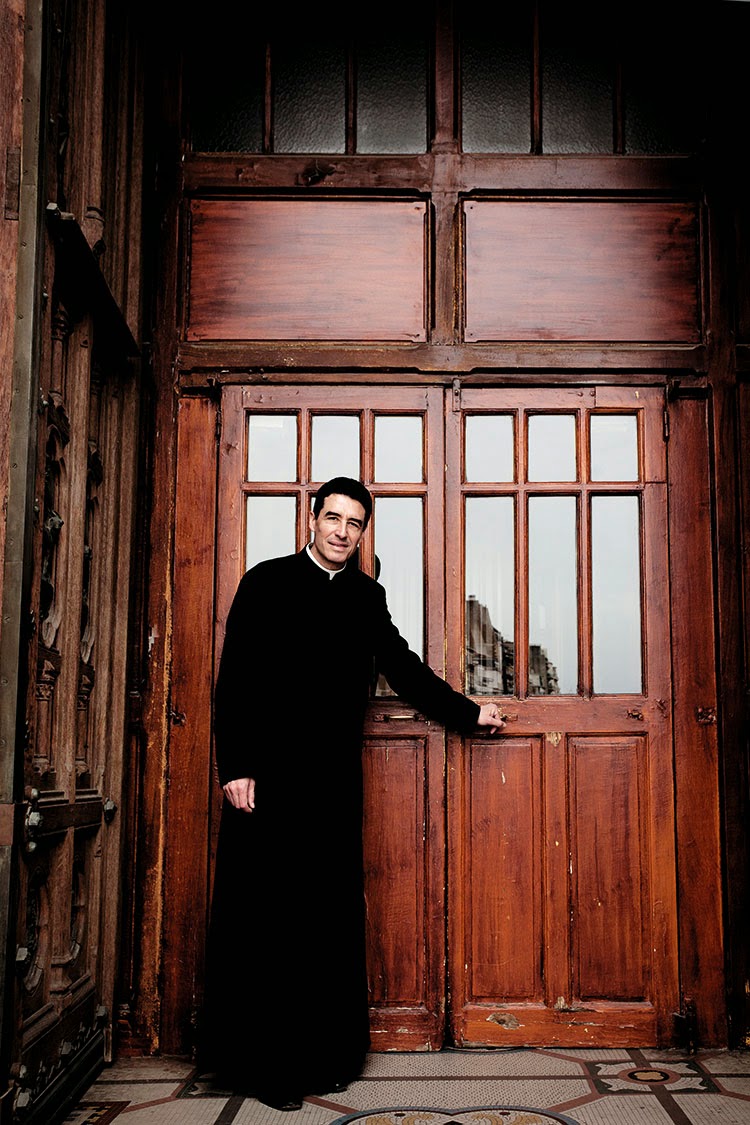
For the last decade Fr. Michel-Marie Zanotti-Sorkine has walked the gritty streets of Marseille, France in a cassock. He walks the streets so that he might know all of his people, and he patiently waits for them every evening in the confessional. He has brought many back to the faith, and has earned the respect of all the people of the diverse seaside metropolis. The parish he was given was once almost empty, and now it is the busiest parish in Marseille. His example has not gone unnoticed. In fact, he has even inspired the good Archbishop Leonard of Brussels to found the Fraternity of the Holy Apostles after Fr. Zanotti-Sorkine's example. The Fraternity has begun with three priests and seven seminarians, and has recently found a home in the once-closed old St Catherines'. Like Father Zanotti-Sorkine, they walk highly-secularized Brussels in cassocks, and they bring the Gospel and sacraments to those who wouldn't otherwise seek them.
Fr. Zanotti-Sorkine has given us a model for how to re-evangelize the West. He offers something old and something new to bring his people to the wedding feast of our Lord. With his traditional dress, devotion to the confessional, and reverent mass he has reached deep into the time-honored treasures of the Church, and has been called another Cure of Ars. His commitment to walking the neighborhoods is reminiscent of the early Franciscans and Dominicans, and represents the perennial missionary spirit of the Church. He has also been adept at using modern technology to reach people through various forms of media: books, interviews, online sermons and even music. God seems to have given him more hours in the day than the rest of us, and his success has earned him more than his fair share of critics. Some critics find him too traditional, other critics object to the fact that he gives our eucharistic Lord to prostitutes (I would be ecstatic if some of the prostitutes I see every week would join me in confession and mass!), or that he has an attractive website and following. He has taken some pastoral risks, but has also shown great faith in laboring for the Lord. Who knows how long he walked the streets in his cassock before people finally relaxed and welcomed him? And who knows how long he sat in the confessional--night after night--before people finally began to trickle in? In his ten years at the parish of St. Vincent de Paul, the good father has shown us that Catholicism still works. What worked for Sts. Francis and Dominic will still work for today, and what revitalized the village of Ars under St. Vianney can still happen in parishes today.
![]() |
| Fr. Sorkine and the Fraternity |
Fr. Zanotti-Sorkine has recently taken a new assignment at the Shrine of Our Lady of Laus. We wish him all of God's blessings, and also for the good priests and seminarians of the Fraternity of the Holy Apostles.
Wednesday, November 19, 2014
How Blessed Charles was Converted
The other day while doing the ministry I was reading the old Bazin biography of
Blessed Charles de Foucauld. It's my book of choice while walking the streets, while waiting "for something to happen". I came upon the part of the book where Blessed Charles first met
the priest who was to play a decisive role in bringing him back to the
Church. He met Father
Huvelin at a fashionable salon or evening party when he was fresh off his great success as an explorer and geographical writer. Charles was a sought-after personage at the time, yet his soul was restless. Unbeknownst to himself, his soul was ripe for conversion as his objects of desire had faded in disillusion. First he had tasted of life as a young viscount, as a man of exquisite luxury and as a man with an amiable mistress. Then he had excelled in perilous situations as few men do: first as a cavalry officer in combat and then as an undercover explorer in the hard, hostile land of North Africa. While he had finally come into his manhood and sense of himself, there was still an unease that dogged him. He was aware that he lacked the peace and ease of spirit that marked his devout relations, and their Christian example was not lost on him.
But what Charles needed was a catalyst, to meet just the right person or more accurately, just the right friend. He found that in Father Huvelin. It seemed like a "chance" encounter at the salon, though we know that with God there is no element of chance. Father Huvelin had gone to the best of schools, though he was not at ease with the luxury and the privilege of high society. The Bazin biography tells us that he "did not try to be smart" in Charles's presence, but was just himself: an unassuming blend of simplicity, profundity and earnestness. Somehow, perhaps by an instinct in the soul, the two men recognized in each other a common bond and joined destiny. Bazin beautifully tells us that "“they recognized and waited for one another in their hearts", and later considered their meeting "a great event”.
I was amazed at reading these passages because they capture the central purpose of the apostolate. Blessed Charles's own conversion is a model of how the apostolate approaches the spiritually famished in order to forge a genuine connection. While life-changing friendships are rare, we walk the streets in the hope that God will put us in just the right place to meet just the right person. A conversion to Christ usually comes through human relationships, and this makes sense when you consider that the committed faithful are members of Christ's own mystical body. Thus, if we share in Christ's divine life, then in meeting us they are meeting Christ in us. God has given all of us a great privilege and responsibility to go out and bring Christ to others, and the surest way of bearing Christ is through the Eucharist.
Tuesday, November 4, 2014
How the Apostolate Began, Part IV
I continued to sketch the ministry in writing for that day and the next. Just as the apostolate unfolded on paper, so did the purpose of my life begin to unfold in my mind. I became certain that the apostolate was as central to my life's calling as my vocation to be a husband and father, as well as my vocation to share the truths of the faith through writing. From the beginning of time we are all fashioned to play our specific part in God's perfect plan of salvation. In a sense, we are supernaturally "stamped" with qualities, traits and desires that lead us--amidst the freedom of our choices--to the purpose God has for us. Thus, if a woman has been given the gift of motherhood, there's a mystical sense in which she has carried that calling with her throughout her life. Even as a little girl she has been "stamped" in the image of motherhood, just as an acorn carries with it the "plan" to be an oak tree.
I began to understand that my past experiences in prison and academia had laid the groundwork--were the preparatory crucible--for my future work as a street evangelist. My own past was being unlocked before me, and treasures were brought forward amidst my past sufferings and sins. I began to finally see all the pieces of my life as a coherent whole: the long walks in every kind of weather, the abiding care for at-risk youth, ex-cons and prostitutes, the intellectual desire to understand human history and defend the truth, the love for the fading treasures of the Catholic tradition, and lastly, the need for Christian brotherhood that is a nobler friendship than the solidarity I found amongst the "solid cons" in prison.
The concerns and pre-occupations that gripped me also seemed to be some of the weakest parts of the Church in the "developed" West. The apostolate seemed to effortlessly provide a remedy for many of the needs of the Church: the need to re-claim and model a deeper sense of prayer and worship, the revival of a spirit of reparation, the need to reestablish a public prophetic witness, the need to go out and find poor sinners where they languish amidst spiritual starvation, and the recovery of Catholic masculinity and friendship.
I began to understand that my past experiences in prison and academia had laid the groundwork--were the preparatory crucible--for my future work as a street evangelist. My own past was being unlocked before me, and treasures were brought forward amidst my past sufferings and sins. I began to finally see all the pieces of my life as a coherent whole: the long walks in every kind of weather, the abiding care for at-risk youth, ex-cons and prostitutes, the intellectual desire to understand human history and defend the truth, the love for the fading treasures of the Catholic tradition, and lastly, the need for Christian brotherhood that is a nobler friendship than the solidarity I found amongst the "solid cons" in prison.
![]() |
| Where's the brotherhood among Catholic men? |
The concerns and pre-occupations that gripped me also seemed to be some of the weakest parts of the Church in the "developed" West. The apostolate seemed to effortlessly provide a remedy for many of the needs of the Church: the need to re-claim and model a deeper sense of prayer and worship, the revival of a spirit of reparation, the need to reestablish a public prophetic witness, the need to go out and find poor sinners where they languish amidst spiritual starvation, and the recovery of Catholic masculinity and friendship.
In the initial burst of thinking and writing on the ministry, I envisioned a small army of like-minded laymen tromping through the cities, with some men even serving as full-time missionaries, and some of the single men living together in run-down urban Jesus Caritas houses. I thought the ministry might help test young men who were discerning a call to the priesthood. They could spend a year walking the streets, and recent college graduates could also spend a year or two before they met their spouse and got on with "real" life. I knew it would take a miracle for the apostolate to become what I envisioned, but I half-expected a miracle since I had been haunted by the supernatural since my conversion. But if I had paid closer attention to the life of Blessed Charles and his lonesome ministry, then I would have known that these were only daydreams. I confess them now so that you might know my foolishness.
What is clear is that the ministry will always be a part of my life until I am overcome by old age. It's become a part of who I am, just as it sprung from my own hopes and pre-occupations. I may only write about the ministry in fits and starts, but I'll always walk the streets in the hope that God will put me in just the right place at the right time.
Monday, November 3, 2014
How the Apostolate Began, Part III
I still wasn't wholly convinced that Blessed Charles de Foucauld was the right patron for the ministry until I understood that there was an analogy between the modern cities of the West and the Muslim tribes of Blessed Charles' beloved desert. Just as the tribes practiced a crude form of syncretist Islam that was adapted to their tribal society, so do many Christians in the West adapt the faith to the contemporary impulses of materialism, new age, and false notions of autonomy and sexual liberation. Both peoples move amidst the comforting signs and symbols of religion or spiritual yearnings but without the transforming power of an encounter with the living God. And so both peoples travel through a spiritual desert with an apparent disinterest in the leaven of Christ's love--a leaven that can permeate a society and raise our hearts up the kingdom of God.
Then I remembered the three groups of people that God had shown me outside the gallery, and reflected on how Blessed Charles might minister to them. It was clear that the three groups of people represented three different states of soul, or three fundamental dispositions we may have toward God. We can live in the friendship of Christ, we can be driven on by a zest for sin and live squarely against Christ, or we can live apart from Christ amidst sorrow and dis-illusion over our fallen idols. The last state is really just the state of the prodigal son, and is a fertile ground for a deep, lasting conversion.
I thought that if Blessed Charles met the family who lived in the friendship of Christ, that he would offer Christian hospitality and fellowship--recognizing the divine life of Christ that is in all Christ's friends. Blessed Charles's life of radical Christian discipleship would also provide a salutary example, just as street ministry suggests a more radical expression of the Christian life. The apostolate could offer a gentle impetus for Christians to go deeper in the faith, and it would also reassure those evangelicals and pentecostals who equate Catholicism with a luke-warm faith.
If Blessed Charles met the poor man who had turned his back on Christ, Blessed Charles would show him the love of Christ and the "peace that surpasseth all understanding". He would offer prayer and sacrifice for the poor man, and humbly bear his scorn. He would only show him love, and if that love were humble and true, then the man may recognize it and a slow movement may begin in his soul.
If Blessed Charles met the woman who was ripe for conversion he would set aside everything else, and begin the walk of faith with her. He would offer prayer, catechesis, books and a ready ear for questions and concerns. He would patiently remain with her through the ups and downs as conversion can be a rocky process since that person's soul becomes the center of a great spiritual tug o' war. He would be mindful that the woman may have rejected the faith in the past because she had never met a person transformed by Christ. The goal of the apostolate must be to become a "little Christ" so that others may see Christ in us. In witnessing our humility, patience and supernatural charity they will begin to believe that there really is something to the ancient faith, and that it's a bracing alternative to the little dry gods of modern culture.
After reflecting on these things it became clear that Blessed Charles was certainly the right patron for the ministry. As I considered his life and example, the heart and mind of the apostolate gently unfolded before me.
To be continued...
Thursday, October 30, 2014
How the Apostolate Began, Part II
I understood that to be an effective street evangelist, my appearance would need to signal to people why I was out on the streets as well as offer an attractive presence. The Mormons announced themselves by their wholesome yet corny uniform, and the fundamentalists used a sign. I decided that a sign was awkward and immobile and so I would need a uniform of some kind. But what kind? Maybe a t-shirt or sweatshirt with a cross and large lettering: "ASK ME WHY I'M CATHOLIC" or "DO YOU KNOW CHRIST?" No, that wouldn't do. I wanted something more timeless--more Catholic--as well as something that even passing cars could recognize and consider. Then I remembered a strange experience, a supernatural fragment from two years ago.
The monks of Papastronsay had sent me a book in the form of a magazine about Blessed Charles de Foucauld. It was the old biography by Rene Bazin supplemented by dozens of vintage photographs. I had never heard of this saint, but I was impressed by his photo on the cover. I thumbed through the magazine and then forgot the book amidst the pile on my desk. After all, what would a monk and evangelist to the muslims have to do with me? Then a year later, about the time of his feast day (December 1st), Blessed Charles stepped into my life through an interior vision. He stood slightly bent with his hands clasped before him. He was a small humble presence who seemed to be housed in my soul. He said nothing, but merely looked at me for a few moments from within me. And then he was gone.
I didn't know what to do with this experience, and so I dug the magazine out from the pile on my desk and read it. I presented the magazine to my spiritual director, and said with embarrassment, "He appeared to me from inside of me." I was surprised when my director looked pleased, and announced that he was very fond of Blessed Charles. We concluded that Blessed Charles must be one of my heavenly patrons, and that God was reminding me--through Blessed Charles--that humility is the central lever for spiritual growth.
But two years later I now saw the experience in a deeper light. Blessed Charles's prayerful witness and example of Christian brotherhood to non-believers was the ideal recipe for evangelization in the post-Christian West. Moreover, Blessed Charles's religious habit with the Holy Cross emerging from Christ's Sacred Heart was the perfect starting point for constructing a uniform. The heart and cross offer the perfect message of love and sacrifice as well as soothing the fears of those I might encounter. I could make a short tunic that was modeled after Blessed Charles habit, though it would need to avoid the particular marks of religious dress. Then I recalled that in past centuries, some lay people would wear distinctive dress that identified them as a member of one of the Third Orders (Dominican, Benedictine, etc). Emboldened by this precedent, I asked Blessed Charles for his patronage and began sketching out a tunic. I decided that a wool tunic with a prominent Jesus Caritas heart/cross would be unusual enough to be unmistakable to passers-by on foot and car. There would be no mistaking what I was up to. Moreover, wool is remarkably versatile and could be worn throughout the change in seasons.
To be continued...
Tuesday, October 28, 2014
How the Apostolate Began, Part I
After All Saints' Day Mass of last year I took our daughter to visit the art gallery where my wife works. We saw the new exhibit for November, played on the stairs, and then headed out the front door for home. As I left the gallery I noticed a husband and wife with their twenty-something son and daughter waiting for a table at a restaurant. As soon as I saw them, I also understood something much deeper than their generally pleasing appearance. By a divine grace I could read the general state of their souls, and the whole family lived in the friendship of Christ. I stared at them and they were gracious enough to smile at me. I thought, "They must be devout Christians." Then a young man briskly passed in front of me reading something on his iphone. My thoughts were interrupted. There was a shadow over this young man, as well as a hardness and determination. He had turned his back on God, and was not receptive to grace. I watched him as he continued down the sidewalk. I thought, "That used to be me." Then I noticed a brunette woman in her mid-30s who wore a scarlet and gray skirt suit. She was crossing the sidewalk in the usual way, but I understood she was in turmoil. Whatever had gratified her in the past had fallen away, and she was now bare, confused and ripe for grace. All she needed was the right person to introduce her to Jesus. I knew I wasn't the right person to do that--at least, not yet.
When I got back to the car I mechanically fastened my daughter into her car seat and wondered what God was up to. Why did God show me those people and the state of their relationship with him? Was he showing me a need, and inviting me to do something about it? That must be it! But what? I don't even know them, or the millions of others like them. How could I be of use to them unless I took the faith to the streets? I pondered the possibilities on the drive home and was grateful when my daughter fell asleep. That would give me more time to think and reflect on what had happened. As I reached 50th and Powell I noticed a young Mormon missionary that I had spoken to a few months back. He was gesturing enthusiastically to a shabbily dressed man while his fellow missionary looked on. I was surprised that their mission territory extended this far out. Then it hit me. This might be a sign. I asked, "God, do you want me to be a street missionary like the Mormons? That must be it!" Then I drove another twenty blocks and was astonished to see a young black preacher camped out on the corner only two blocks from my house. He had never been there before. A young white man stood next to him holding a large ugly sign--the kind of street sign that mattress stores use when "everything must go". I read the sign: "Repent or perish...Now's the time..." followed by some scripture. The preacher looked angry and the young man looked defiant.
They wouldn't win any converts with that approach, but at least they were trying to witness. After all, where were the Catholics--those graced with the faith that Jesus passed down to his disciples? My heart sank for our dear Lord. His only representatives were a pair of fundamentalists and some eager but confused Mormons. It couldn't be a coincidence that I had seen these street missionaries on this afternoon. God has a perfect plan, and every piece moves in harmonious purpose with every other piece. God had arranged for me to be in the exact place and time to see three different states of soul, and two different examples of street ministry, and in just twenty-five minutes!
When I got home I grabbed a fresh yellow legal pad and sat down. Words and ideas streamed from my mind with remarkable clarity and conviction. It was effortless. I thought, "This must be the Holy Spirit..." Then I remembered Blessed Charles de Foucauld and something that had happened two years before.
To be continued...
When I got back to the car I mechanically fastened my daughter into her car seat and wondered what God was up to. Why did God show me those people and the state of their relationship with him? Was he showing me a need, and inviting me to do something about it? That must be it! But what? I don't even know them, or the millions of others like them. How could I be of use to them unless I took the faith to the streets? I pondered the possibilities on the drive home and was grateful when my daughter fell asleep. That would give me more time to think and reflect on what had happened. As I reached 50th and Powell I noticed a young Mormon missionary that I had spoken to a few months back. He was gesturing enthusiastically to a shabbily dressed man while his fellow missionary looked on. I was surprised that their mission territory extended this far out. Then it hit me. This might be a sign. I asked, "God, do you want me to be a street missionary like the Mormons? That must be it!" Then I drove another twenty blocks and was astonished to see a young black preacher camped out on the corner only two blocks from my house. He had never been there before. A young white man stood next to him holding a large ugly sign--the kind of street sign that mattress stores use when "everything must go". I read the sign: "Repent or perish...Now's the time..." followed by some scripture. The preacher looked angry and the young man looked defiant.
![]() |
| This is not a winning strategy |
They wouldn't win any converts with that approach, but at least they were trying to witness. After all, where were the Catholics--those graced with the faith that Jesus passed down to his disciples? My heart sank for our dear Lord. His only representatives were a pair of fundamentalists and some eager but confused Mormons. It couldn't be a coincidence that I had seen these street missionaries on this afternoon. God has a perfect plan, and every piece moves in harmonious purpose with every other piece. God had arranged for me to be in the exact place and time to see three different states of soul, and two different examples of street ministry, and in just twenty-five minutes!
When I got home I grabbed a fresh yellow legal pad and sat down. Words and ideas streamed from my mind with remarkable clarity and conviction. It was effortless. I thought, "This must be the Holy Spirit..." Then I remembered Blessed Charles de Foucauld and something that had happened two years before.
To be continued...
Subscribe to:
Posts (Atom)